
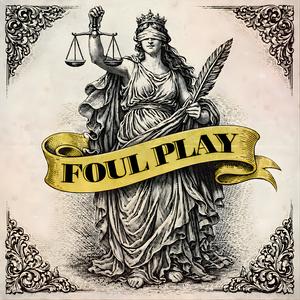
Foul Play: A Historical True Crime Podcast
Shane L. Waters, Wendy Cee, Gemma Hoskins

Seneste episode
327 episoder

Start Here: Welcome to Foul Play
24.10.2026 | 2 min.Foul Play is historical true crime, built from the records that survive. Every week Shane Waters goes back to a real crime that history tried to bury and tells it plainly, with respect for the people in it, the victims most of all.
In this trailer: the Bender orchard in Kansas, 1873. Katsu Goto's last ride home in Hawaii, 1889. Mollie Korbel's kitchen in Dakota Territory, 1888. And Hamburg, South Carolina, on the nation's hundredth birthday in 1876.
There are more than 300 episodes waiting. Start anywhere, and follow Foul Play so the next story finds you.
Our Sponsors:
* Check out Kensington Publishing: https://www.kensingtonbooks.com
Advertising Inquiries: https://redcircle.com/brands
Privacy & Opt-Out: https://redcircle.com/privacyDelaware & Montana: What the River Knows
20.10.2026 | 34 min.Season 40: America's 250th -- fifty true crime stories from fifty states. Delaware, 1891. A headless body in a
commercial canal, the head never recovered. Montana Territory, 1889. A drifter murders five settlers on the open
prairie, dumps them in a river, and dies before trial. His coffin, when checked, was empty.
Two waterways. Two states. Two historical murders where the water held the dead and refused to give them
back.
The Victims
**Noah Benson** was pulled from the Chesapeake and Delaware Canal in 1891 -- a headless body floating
in one of America's busiest commercial waterways. In an era before fingerprints, dental records, or circulated
photographs, the human face was the only reliable means of identification. Benson's had been taken from him.
That investigators identified him at all, through physical markings or recognition by people who knew him, speaks
to the determination of a county with no state police force and no forensic capability beyond what constables
could see with their own eyes.
**Edward and Lucina Crowell Biggs**, **Joseph and Sarah Ellen Jolliff Kurtz**, and six-year-old **Ida Schauss**
were settlers heading northeast from Helena toward the gold-mining town of Maiden in the Judith Mountains.
Ida had been formally adopted by the Kurtzes in January 1889, just months before the journey. Her biological
father, Julius Schaus of Helena, recently widowed, had placed her in the couple's care through a formal adoption
granted by Judge Howey. Sarah Kurtz, a farmer's wife of fifteen years from Iowa, knew what it took to start over.
She did not know that the man offering to guide them through the Judith Basin was planning to kill them all.
The Crimes
In Delaware, the canal that ran fourteen miles through the flatlands of northern Delaware -- connecting the
Delaware River to the Chesapeake Bay since 1829 -- gave up Benson's body but kept the one piece that mattered
most. His head was never found. A murder trial followed, drawing weeks of coverage from the *Every Evening*,
the *Morning News*, and the *Evening Journal* out of Wilmington. The prosecution had to prove who Benson
was, prove he had been murdered, and prove who did it, all without the single piece of evidence that could have
simplified everything.
In Montana Territory, **James Wilber** -- also known as Jack Gilding -- met the five settlers in Helena and offered
to guide them to Maiden. The last person outside the party to see them alive was John Beck at Castle Butte
on June 7, 1889. That evening or night, Wilber shot all five with a Winchester rifle. He loaded the bodies into
the wagon, drove through open country in daylight, and dumped them in the Judith River at Samples Crossing,
roughly twenty miles south of Lewistown.
The Investigations
Delaware's law enforcement in 1891 relied on county constables and local sheriffs. There was no state police force
(Delaware State Police would not be founded until 1923). Investigators worked without fingerprinting technology,
forensic pathology, or the victim's head. The trial reportedly concluded with a verdict, but the details remain
buried in the Delaware state archives and on microfilm at the Wilmington Public Library -- waiting for whoever
goes looking.
In Montana, a cowboy from the Moccasin roundup found a woman's body in the Judith River on June 15. Within
days, all five bodies had surfaced. The *Fergus County Argus* declared on June 20 that never in the history of
Montana had such a crime been committed. Sheriff Clary traced Wilber through a horse trade at James Wood's
ranch near Stanford. Deputy Jo. Hamilton and Sheriff Downing of Cascade County tracked him to Great Falls
and arrested him. On the night of Friday, June 21, 1889, Wilber hanged himself in his cell with his own belt. There
was no trial.
Historical Context
Delaware in 1891 maintained one of the harshest criminal justice systems in the nation. The whipping post,
known locally as "Red Hannah," was still in active use -- disproportionately against Black defendants -- and would
remain so until 1972. The canal corridor was a place between identities: Major Philip Reybold and his five sons
had once planted over 117,000 peach trees across two states, but peach yellows disease was killing the groves.
The canal itself would later be purchased by the federal government, widened, deepened, and converted from a
lock-controlled passage to a sea-level waterway. Even the crime scene was consumed.
Montana was admitted as the 41st state on November 8, 1889 -- five months after the murders. The Wilber case
was the last great crime of the territorial era. And one final mystery remained: when someone later checked
Wilber's grave at Highland Cemetery in Great Falls, the coffin was empty. The body was never found. A man who
tried to make five people disappear into a river himself disappeared from his own grave.
Our Sponsors:
* Check out Kensington Publishing: https://www.kensingtonbooks.com
Advertising Inquiries: https://redcircle.com/brands
Privacy & Opt-Out: https://redcircle.com/privacyArkansas & Michigan: Town Secrets, 1875-1912
13.10.2026 | 35 min.Season 40: America's 250th — 50 states, 50 forgotten crimes. Two communities. Two murders decades apart.
In the Arkansas Ozarks, a town rushed to convict a man on circumstantial evidence and may have hanged the
wrong person. In northern Michigan, an entire town conspired to kill its tyrannical founder — then said nothing
for sixteen years.
In 1912, eighteen-year-old Ella Barham walked to a post office in the Arkansas hills to buy cloth for a hat. She
never came home. Her dismembered remains were found scattered across a hillside that night. The community
blamed a neighbor named Odus Davidson. He was hanged within nine months. His gravestone still declares he
was innocent.
The Victims
Ella Lillian Ethel Barham was born February 16, 1894, in the Pleasant Ridge community of Boone County, Arkansas
— a scattering of homesteads along Crooked Creek in the Ozark hills. Her father, George Solomon Barham, was
one of the largest landowners in the county. Ella was eighteen, described by neighbors as popular and well-liked.
On the morning of November 21, 1912, her world measured in creek crossings and ridge trails. Her biggest concern
was a hat.
In Michigan, the victim was Albert Molitor — born 1842 in Ludwigsburg, Germany, founder of Rogers City and
the political architect of Presque Isle County. He built the sawmill, the store, the boarding house, the post office.
He paid workers in scrip redeemable only at his store. He declared himself "the King of Presque Isle County." He
was thirty-three when fifteen men decided he had to die. But the shooting that killed Molitor on August 23, 1875,
also killed Edward Sullivan — a clerk working late, a bystander, a man whose death nobody conspired to avenge.
The Crimes
In Arkansas, Ella Barham's remains were found around 9:00 p.m. by two boys and a hunter on a hillside south of
Crooked Creek. She had been decapitated, severed at the torso, both legs removed, and nearly every bone in her
skull crushed. Doctors Taylor and Lair determined she had been sexually assaulted, possibly by more than one
person. Neighbor Odus Davidson — twenty-nine, known to have expressed romantic interest Ella rejected —
was arrested within days. His seventeen-year-old brother Lair was taken in as an accomplice.
In Michigan, buckshot from at least two guns tore through the mill office where Albert Molitor and clerk Edward
Sullivan worked. Fifteen to twenty pieces of shot struck Molitor in the back and side. Sullivan took a blast through
the jaw that severed his tongue. Sullivan died the next day on a boat to Alpena. Molitor lingered approximately
three weeks before dying in Detroit.
The Investigations
The Davidson case was built entirely on circumstantial evidence: threatening statements Odus made after Ella's
rejection, red pepper-filled socks dropped from a Davidson window to confuse bloodhounds, a bloody axe at the
family woodpile, and Davidson's reluctance to join the search party. No confession. No eyewitness. No forensic
evidence that would meet modern standards. The trial before Judge George Reed lasted five days. Davidson was
not present when the jury returned its verdict of murder in the first degree after four hours of deliberation. He
was sentenced to hang.
Attorney E.G. Mitchell — a former circuit court judge — fought the conviction through the Arkansas Supreme
Court and lobbied the governor for clemency. Every effort failed. On August 11, 1913, Odus Davidson was hanged
in Harrison before a crowd numbering in the thousands. His final words were a declaration of innocence. The
rope was cut into pieces and thrown to the crowd as souvenirs.
In Rogers City, there was no investigation — not a real one. Nobody particularly wanted to find the killers. For
sixteen years the community kept its silence. In 1891, farmer William Repke turned himself in and named fourteen
other conspirators. He identified Hermann Hoeft, a rival store owner, as the mastermind and Andrew Banks as
the orchestrator. When authorities tried to seat a jury in Presque Isle County, they summoned, examined, and
dismissed 252 prospective jurors. The entire eligible pool. The trial moved to Alpena County. Five men were
convicted and sentenced to life with hard labor at Jackson State Prison. Approximately five years later, the
governor pardoned four; the fifth was pardoned roughly two and a half years after that.
Historical Context
Both cases reveal how justice operated in isolated American communities before professional law enforcement
and modern forensics. In Boone County, Arkansas, grief and certainty replaced due process. In Presque Isle
County, Michigan, a community decided collectively that a killing was deserved — and the state eventually
agreed by pardoning the convicted men. Davidson's appeal has been cited as legal precedent in numerous cases,
including the 1915 Leo Frank appeal to the U.S. Supreme Court.
Our Sponsors:
* Check out Kensington Publishing: https://www.kensingtonbooks.com
Advertising Inquiries: https://redcircle.com/brands
Privacy & Opt-Out: https://redcircle.com/privacyThe Bloody Benders and the Lunenburg Women: Kansas & Virginia
06.10.2026 | 35 min.The Bloody Benders killed travelers at their Kansas inn and vanished in 1873. In 1895 in Lunenburg County, Virginia, Mary Abernathy, Pokey Barnes and Mary Barnes were convicted of killing Lucy Pollard on testimony the witness later admitted was false. All three went free.
The Benders ran an inn on the Osage Trail in Labette County, Kansas, and for two years travelers went missing there. At least 11 victims were found buried in the orchard and the well, among them Dr. William York and an 18-month-old girl, Mary Ann Longcor. The family was gone before the bodies were found, and the 3,000 dollar reward was never claimed.
Lucy Pollard, 56, was killed in her farmyard in Fort Mitchell, Virginia, on June 14, 1895, as she walked out to collect eggs. Solomon Marable named three women and all three were convicted. Pokey Barnes cross-examined Marable herself and he admitted what he first said was false. With support from John Mitchell Jr. and the Richmond Planet, Pokey Barnes and Mary Abernathy won new trials and went free, and the governor pardoned Mary Barnes, who walked out on Christmas morning 1896.
Content note: the deaths of at least 11 people including a toddler, a plain description of a woman's injuries, an execution, and death sentences handed to Black defendants on testimony the witness later admitted was false.
Foul Play, Season 40: America's 250th Anniversary. Fifty states, fifty crimes. This is Episode 15.
Our Sponsors:
* Check out Kensington Publishing: https://www.kensingtonbooks.com
Advertising Inquiries: https://redcircle.com/brands
Privacy & Opt-Out: https://redcircle.com/privacyThe Hamburg Massacre and Cherokee Bill: South Carolina & Indian Territory
29.09.2026 | 35 min.In 1876 an armed white mob killed six Black men in Hamburg, South Carolina, and not one of 94 men indicted was tried. That year Crawford Goldsby, later Cherokee Bill, was born; after Ike Rogers helped capture him, Goldsby was hanged for murder at Fort Smith in 1896.
On July 8, 1876, more than 100 armed white men attacked the Black militia of Hamburg, four days after a parade dispute over a road. They killed town marshal James Cook and Moses Parks, then shot four men they had captured, Allan Attaway, David Phillips, Hampton Stephens and Albert Myniart. A coroner's jury produced 94 indictments, including Benjamin Tillman, and no one was ever tried. Tillman became governor of South Carolina and a United States senator.
Crawford Goldsby was born at Fort Concho, Texas, that same year, the son of a Buffalo Soldier and a Cherokee freedwoman. As Cherokee Bill he rode with the Cook Gang. Judge Isaac Parker's federal court at Fort Smith, Arkansas, convicted him of murdering Ernest Melton, a painter who stepped to a window during a robbery at Lenapah, and jail guard Lawrence Keating, who left a wife and children. He was sentenced to death twice and hanged on March 17, 1896, at age 20. Rogers was shot dead by Goldsby's brother in 1897.
Content note: racial violence, a massacre, a state legislator shot while praying, the shooting of a bystander and a jail guard, and a public hanging.
Foul Play, Season 40: America's 250th Anniversary. Fifty states, fifty crimes. This is Episode 14.
Our Sponsors:
* Check out Kensington Publishing: https://www.kensingtonbooks.com
Advertising Inquiries: https://redcircle.com/brands
Privacy & Opt-Out: https://redcircle.com/privacy
Flere Historie podcasts
Trendige Historie podcasts
Om Foul Play: A Historical True Crime Podcast
Foggy gaslit streets. A quiet courtroom. And crimes that history tried to bury.Foul Play is a historical true crime podcast that investigates the most chilling murder cases from the 1800s and early 1900s across the United States and the United Kingdom. Hosted by investigative crime journalists Shane Waters — who pioneered crime podcasting in 2008 — and Wendy Cee, each season unravels one complete criminal case through original research, court records, and primary source material.This isn't sensationalized true crime. Every season of Foul Play puts victims first — their names, their stories, their humanity — before examining how murder investigations unfolded in an era before modern forensics, when justice was far from guaranteed.From Victorian poisoners in London to Gilded Age killers in America, Foul Play brings historical true crime to life with cinematic storytelling and relentless accuracy. Every fact is verified. Every claim is sourced. Every story is told with the gravity it deserves.New seasons of this historical true crime podcast release throughout the year, with episodes dropping weekly on Tuesdays.Hello, friend. Welcome to Foul Play.
Podcast-webstedLyt til Foul Play: A Historical True Crime Podcast, Hitlers Æselører og mange andre podcasts fra hele verden med radio.dk-appen
Hent den gratis radio.dk-app
- Bogmærke stationer og podcasts
- Stream via Wi-Fi eller Bluetooth
- Understøtter Carplay & Android Auto
- Mange andre app-funktioner
Hent den gratis radio.dk-app
- Bogmærke stationer og podcasts
- Stream via Wi-Fi eller Bluetooth
- Understøtter Carplay & Android Auto
- Mange andre app-funktioner

Foul Play: A Historical True Crime Podcast
Scan koden,
download appen,
begynd at lytte.
download appen,
begynd at lytte.
 Denmark