

13 episoder
Episode 12 | EU Sanctions Case Law | Mid-2026 Review with Francesca Finelli & Celia Challet
17.07.2026 | 44 min.Nine consecutive Foreign Affairs Council meetings have adopted Russia-related sanctions, and 250 new listings are being prepared — the largest single round since 2022. Yet the 21st package remains under negotiation. Meanwhile, EU sanctions policy needs to tackle other issues such as the situation in Sudan, or contingency planning as the US-Iran MoU is now, in President Trump's own words, "over."
Amid this volatility, Jan Dunin-Wasowicz takes a step back with two EU sanctions scholars — Celia Challet (Université Catholique de Lille) and Francesca Finelli (University of Luxembourg) — for a mid-year review of what's been happening before the EU courts since January 2026. Topics include:
The Pumpyanskiy appeal and the Court of Justice's ruling on criterion (g), the "leading businesspersons" listing criterion
Why Russian oligarchs remain the core litigants — and the new categories of applicants now reaching Luxembourg: shadow fleet operators, third-country companies, the Russian Central Bank, and even Hungary and Slovakia
The Global 8 Airlines case and the pending appeal that could reshape a key element of the EU's sanctions architecture
Euro Asia Cargo and what the ruling means for third-country operators' compliance obligations and the anti-circumvention logic behind EU sanctions
EM System and T Trust: how the Court has expanded the scope of asset freezes to reach 50%-owned companies and trust structures, and the cross-fertilisation between sanctions law and anti-money laundering law
Traugott Ickeroth: the broadcasting ban, personal blogs, and why the Court broke from the Commission's own FAQ guidance
Pending cases to watch: Reibel (arbitration and the no-claim clause) and Inter Rao Lietuva (Member States' power to list additional targets)
Chapters
00:00 – 21st package update
01:54 – Welcoming Celia Challet and Francesca Finelli
02:58 – The core of sanctions litigation: individual applicants and Russian "leading businesspersons"
04:43 – What is criterion (g)?
07:01 – Inside Pumpyanskiy: five cases, one appeal
11:12 – Beyond the oligarchs: who else is litigating?
12:30 – New applicants: shadow fleet operators, third-country companies, and the Russian Central Bank
14:51 – Procedural hurdles: standing and admissibility across different case types
15:24 – Global 8 Airlines and the fight over Commission accountability
19:59 – Circumvention and compliance: the Euro Asia Cargo case
24:58 – Scope of asset freezes: EM System and the 50% presumption of control
29:12 – T Trust: sanctions law meets anti-money laundering law
31:06 – The role of the Commission's FAQs in the Court's reasoning
34:23 – Traugott Ickeroth: broadcasting bans and personal blogs
41:14 – Looking ahead: the Reibel case and arbitration
43:16 – Looking ahead: Inter Rao Lietuva and Member State listings
44:17 – Closing thoughtsEpisode 11 | Iran Relief, Russia Pressure, the "Right Moment" for the G7 Sanctions Coalition?
19.06.2026 | 40 min.June 2026 may prove to be a pivotal moment for Iran and Russia sanctions. Following the G7's summit in Evian, which welcomed the US-Iran memorandum of understanding while explicitly committing to increased pressure on Russia's oil and gas sectors, this episode comes at a special moment.
Jan Dunin-Wasowicz welcomes Dawson Law, founder of Conseil Global Advisors and former Senior Sanctions Policy Advisor at OFAC and US Treasury Representative to the United Kingdom, for a wide-ranging conversation on US sanctions policy and its implications for the EU. Topics include:
What the US-Iran MOU actually commits to, what it doesn't, and what it means for business and compliance
What US sanctions relief on Iran's nuclear program would mean for the EU, given that the MOU leaves human rights, ballistic missiles, and Iran's regional proxies — including support for Russia — entirely unaddressed
The G7's explicit linkage between Hormuz de-escalation and intensified Russia pressure — and whether US action will follow the rhetoric
How US perceptions of the EU as a sanctions actor have evolved, and how the EU has become more disruptive through sophisticated network-based targeting
Findings from a new report on the A7 network, a Russia-linked sanctions evasion network moving over $25 billion through SWIFT, including the use of AI-generated fake invoices
Emerging EU-UK-US convergence on sanctions targeting migrant smuggling, and the secondary sanctions exposure created by US cartel designations in Mexico, Venezuela and Brazil
All of this as the EU extended the Russia sanctions for one year and the 21st package is on the horizon.
Chapters
00:00 – Mid-June 2026 EU Sanctions Update
07:09 – Welcoming Dawson Law
07:39 – What does the US-Iran MOU actually say?
09:26 – A framework, not a final deal
11:16 – Performance-based relief: the undefined conditions
13:03 – Frozen assets, oil export licenses, and political sensitivities
14:10 – The Congressional pathway to sanctions relief
15:32 – Lessons from the JCPOA: legal permission vs. business appetite
19:02 – What the MOU leaves unaddressed — and the EU's overlapping concerns
20:41 – The G7's enthusiasm in Évian — what's driving it
22:08 – The G7's Russia pivot: rhetoric or real action?
25:19 – How the US view of the EU as a sanctions actor has evolved
28:10 – From symbolic measures to network-based targeting
29:52 – The EU, the US, and the G7 as a coordination platform
33:27 – Inside the A7 network: $25 billion in evasion, AI-generated fake invoices
36:08 – Compliance lessons: correspondent banking and pattern detection
38:42 – Closing thoughts: migrant smuggling sanctions and cartel-related exposureEpisode 10 | The 20th Package, New EU Sanctions Momentum? | Maria Demertzis on Economic Statecraft
19.05.2026 | 39 min.EU sanctions are no longer only about restricting trade or freezing assets. Increasingly, they sit at the center of a much wider debate about economic security, resilience, strategic autonomy, and the EU’s ability to project power in a fragmented geopolitical landscape. Beyond law and compliance, how does an economic perspective approach EU sanctions?
Following the recent adoption of the EU’s 20th Russia sanctions package — and what may prove to be a broader turning point in EU sanctions policy — the latest episode of This Month in EU Sanctions welcomes Maria Demertzis, Professor of Economic Policy at the Florence School of Transnational Governance.
The discussion explores the evolving role of EU sanctions, the economics of coercion, and why the future of EU economic statecraft may depend as much on reducing vulnerabilities, finding leverage, and speaking with one voice as on the sanctions themselves.Episode 09 | Navigating EU Sanctions Amid Compounding Crises | Paschalis Paschalidis on Arbitration
13.03.2026 | 45 min.In episode 10 of the podcast, Jan Dunin-Wasowicz provides an update on the latest developments as Russia’s war of aggression against Ukraine enters its fifth year, highlighting how overlapping geopolitical crises are placing new pressure on the EU’s sanctions framework. Against the backdrop of escalating tensions in the Middle East, the discussion underscores the growing complexity of managing intersecting sanctions regimes and the increasing need for strategic readiness in an uncertain global environment.
The episode reflects on recent remarks by Ursula von der Leyen, who has emphasized that the EU can no longer rely solely on the traditional rules-based international system, but must instead “build its own path.” This sets the stage for a broader exploration of the future direction of EU sanctions law and policy, including what a more coherent and autonomous EU sanctions doctrine might look like, and how compliance frameworks must evolve in response to overlapping geopolitical shocks.
The show then welcomes Paschalis Paschalidis for an in-depth discussion on how EU sanctions are reshaping the landscape of international dispute resolution. The conversation examines the growing role of sanctions in driving litigation, arbitration, and complex cross-border disputes, with particular focus on contractual claims, investment protection, enforcement challenges, and jurisdictional questions.
CHAPTERS
00:00 - Overlapping geopolitical shocks and impact on EU sanctions
04:50 - Introducing Paschalis Paschalidis
07:59 - General impact of EU sanctions on the litigation and arbitration practice
08:55 - How do disputes about EU sanctions arise?
12:00 - Mapping sanctions-related claims
16:00 - Anti-suit and anti-anti-suit injunctions
20:08 - New attitudes towards litigation and arbitration
21:05 -The relationship between the EU legal order, sanctions, and arbitration
27:28 - Reviewing awards dealing with EU sanctions issues
29:13 - EU sanctions and investment-state arbitration
33:31 – Force majeure and sanctions clauses
39:34 – Looking ahead: rules-based international order and dispute resolutionEpisode 08 | 2026 EU Sanctions Readiness and Adaptation | Ruta Bajarunaite on the Past, Present & Future of EU Sanctions from a Lithuanian Perspective
04.02.2026 | 54 min.In episode 08 of the podcast, Jan Dunin-Wasowicz provides an update on January 2026 developments, focusing on the importance of readiness in adaptation. The show then welcomes Rūta Bajarūnaitė, Head of the Sanctions Policy Team at the Ministry of Foreign Affairs of the Republic of Lithuania. The conversation touches on the evolving landscape of EU sanctions in response to geopolitical crises, particularly focusing on the implications of Russia's war of aggression against Ukraine. A discussion on the past, present and future of EU sanctions law and policy from a Lithuanian perspective.
CHAPTERS
00:00 January 2026 Updates
03:29 Introducing Rūta Bajarūnaitė, the Lithuanian Framework for EU Sanctions Implementation and Current Priorities
08:03 Lessons from 2022 and Initial Responses to the Full-scale Invasion of Ukraine
19:44 Protecting the EU's External Borders
22:51 Tackling Circumvention of EU Sanctions
25:31 Exemptions & Enforcement
34:40 Interpretation - the Notion of Control
39:52 Compliance Expectations - the Example of Best Efforts
46:30 2026 Outlook
Subscribe on LinkedIn https://www.linkedin.com/build-relati...
Subscribe on Substack: https://eusanctions.substack.com/
Hosted on Acast. See acast.com/privacy for more information.
Flere Forretning podcasts
Trendige Forretning podcasts
Om This Month in EU Sanctions
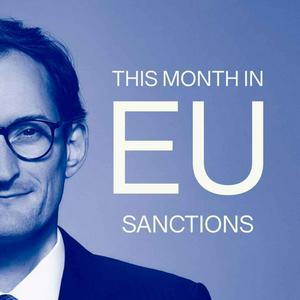
EU sanctions law and policy in the global context. Briefings and discussions at the crossroads of EU law, foreign policy and business. Hosted by Jan Dunin-Wasowicz.This Month in EU Sanctions delivers timely updates and expert analysis of the legal, policy, and practical developments shaping EU security law and trade compliance.With a distinctly European perspective, each episode examines the intersection of law, foreign policy, and real-world practice, offering listeners a deeper understanding of the forces and challenges shaping EU sanctions and trade compliance.The podcast complements the newsletters on LinkedIn and Substack, providing a forum for in-depth insights, reflection, and discussion.
Podcast-webstedLyt til This Month in EU Sanctions, Aktieuniverset og mange andre podcasts fra hele verden med radio.dk-appen
Hent den gratis radio.dk-app
- Bogmærke stationer og podcasts
- Stream via Wi-Fi eller Bluetooth
- Understøtter Carplay & Android Auto
- Mange andre app-funktioner
Hent den gratis radio.dk-app
- Bogmærke stationer og podcasts
- Stream via Wi-Fi eller Bluetooth
- Understøtter Carplay & Android Auto
- Mange andre app-funktioner

This Month in EU Sanctions
Scan koden,
download appen,
begynd at lytte.
download appen,
begynd at lytte.
 Denmark